
The Cars We’re Accidentally Throwing Away
- Rob Barrett
- Jul 6
- 7 min read
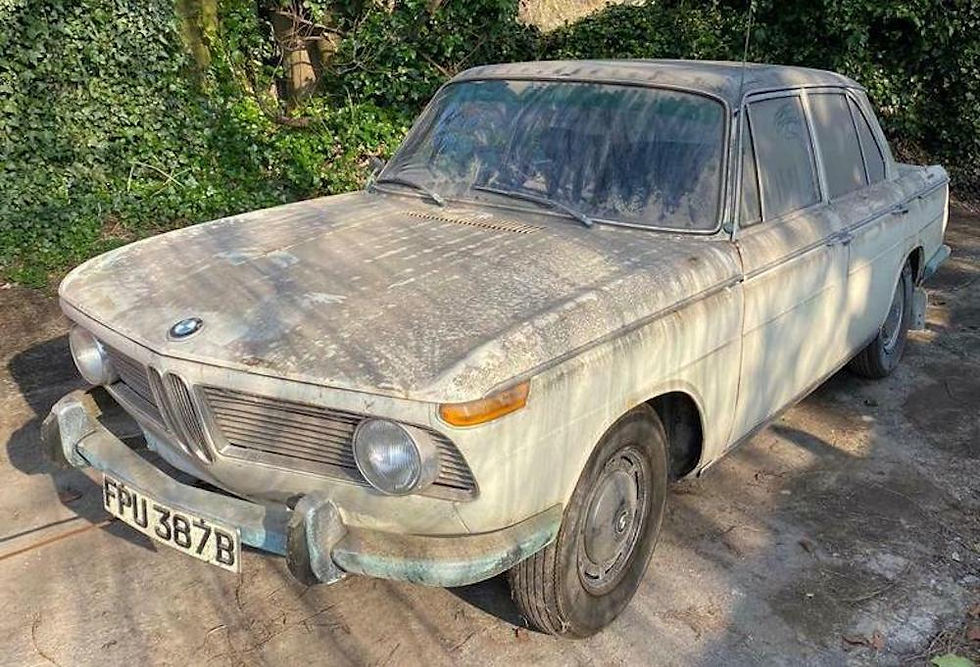
There is a strange moment in the life of almost every collectible car.
It happens somewhere between “that’s just an old used car” and “I can’t believe those are worth that much now.” I think that all the time!!!!
Unfortunately, by the time we reach the second part, most of them are already gone.
They’ve been wrecked. Modified beyond recognition. Left behind a repair shop because the estimate was higher than the car’s value. Donated. Crushed. Turned into parts cars. Or sold to someone’s nephew who immediately installed the cheapest coilovers available on the internet and removed several pieces the original engineers probably considered important.
Then, almost overnight, we decide we miss them.
This is one of the strangest things about car collecting. We are remarkably good at recognizing automotive history after we have destroyed most of it.
And right now, we are probably doing it again.
The Next Collector Car Might Be Sitting Behind a Grocery Store
When people hear the words “collector car,” they tend to picture something expensive.
A vintage Ferrari.
An air-cooled Porsche.
A perfectly restored muscle car sitting under dramatic lighting while two men named Charles discuss provenance.
That world exists. It’s fine. But it has very little to do with how most people actually fall in love with cars.
Most of us didn’t grow up around million-dollar collections.
We grew up around ordinary cars.
The car your dad drove to work.
The strange hatchback your neighbor owned.
The slightly irresponsible car your older cousin bought when he got his first decent job.
The car you desperately wanted in high school but couldn’t afford because your entire net worth was approximately $83 and a skateboard.
Those are the cars that become emotional later.
And emotion is one of the most powerful forces in collecting.
The problem is that nobody protects ordinary cars while they’re still ordinary.
We Save Cars Only After We Decide They Matter
Look at automotive history and you’ll see the same pattern again and again.
A car is new.
Then it becomes used.
Then cheap.
Then very cheap.
Then slightly embarrassing.
Then rare.
Then suddenly everyone wants one.
There is usually a dangerous period in the middle when the car has almost no financial value but still costs real money to maintain.
That is where cars disappear.
A $4,500 car that needs a $3,000 repair is in serious danger, even if that same model might become desirable ten years later.
The math is simple.
The owner doesn’t see a future collectible. They see an old car with a broken transmission, a warning light, and registration due next month.
So the car goes away.
Multiply that decision by thousands of owners and entire generations of vehicles quietly vanish.
Not because they were terrible.
Because they weren’t valuable yet.
The Most Endangered Cars May Be the Ones Nobody Thinks Are Special
This is where things get interesting.
The obvious performance cars usually have someone watching over them.
People know to preserve special Porsches. They know rare Ferraris matter. They understand that limited-production exotics probably shouldn’t be left behind an apartment building with three flat tires and a family of raccoons living in the trunk.
But what about the less obvious cars?
What about the strange trim level?
The failed luxury experiment?
The first generation of some technology nobody understood at the time?
The weird little hot hatch that was inexpensive when new?
The manual version of a car almost everyone bought with an automatic?
The final sedan from a dead brand?
The car that sold reasonably well but somehow disappeared from the road in fifteen years?
Those are the cars worth thinking about.
Because rarity is not always created by low production.
Sometimes rarity is created by indifference.
A Perfectly Ordinary Car Can Become Extraordinary
Imagine seeing a completely original 1995 economy car today.
Not restored.
Not modified.
Not turned into a tribute to something it never was.
Just clean.
Original wheels. Original interior. Factory radio. Maybe even the original dealer sticker still hanging on the back.
Suddenly, something strange happens.
People stop.
They look.
They smile.
Not because the car is fast.
Not because it was expensive.
Because it survived.
A perfectly preserved ordinary car becomes a time machine in a way that a restored exotic sometimes cannot.
You remember the shape of the dashboard.
The sound of the door closing.
The weird fabric.
The buttons.
The smell.
Maybe your mother had one. Maybe your teacher drove one. Maybe you took your first road trip in one while eating gas-station food that probably removed several months from your life expectancy.
That emotional connection matters.
In fact, it may matter more than horsepower.
The Cars of the 2000s and 2010s Are Entering the Danger Zone
This is the era I think we should be watching right now.
Cars from roughly the early 2000s through the mid-2010s are in a fascinating and dangerous period.
Many are old enough to need expensive repairs but not old enough to be considered classics.
Their paint is fading.
Interior plastics are breaking.
Electronic modules are failing.
Replacement parts are getting strange.
Owners are deciding whether a repair is “worth it.”
Insurance companies are totaling them after relatively minor accidents because the market value is low.
And because millions of these cars were built, we assume they’ll always be around.
They won’t.
Common cars can disappear surprisingly fast.
Think about how often you once saw certain models every day. Then think about the last time you saw a clean, original example.
That gap is where future collectibility begins.
We May Be Underestimating the Last Analog Cars
There is another reason this era matters.
We are moving through one of the largest technological transitions in automotive history.
Cars are becoming more connected, more automated, more software-dependent, and in many ways more capable.
That is not necessarily bad.
Modern cars are astonishing machines.
But the transition means we may be approaching the end of certain experiences that once seemed completely normal.
Hydraulic steering.
Simple naturally aspirated engines.
Manual transmissions.
Physical buttons.
Mechanical handbrakes.
Engines you can see without removing seventeen decorative plastic panels.
Cars that do not require a software agreement before allowing you to adjust the temperature.
Today, these things can feel old-fashioned.
Tomorrow, they may feel special.
And history suggests we are usually terrible at recognizing that transition while it is happening.
Cheap Cars Are Where the Interesting Stories Live
The collector-car world has become increasingly obsessed with investment.
What is appreciating?
What should you buy now?
What will be worth more in five years?
That’s understandable. Nobody enjoys losing money.
But reducing car collecting to investment performance misses the entire reason cars matter.
Cars are cultural objects.
They tell stories about who we were.
A first-generation hybrid tells a story.
A failed American luxury sedan tells a story.
A tiny turbocharged hatchback tells a story.
A strange crossover that arrived ten years before the market wanted it tells a story.
A car from a company that no longer exists tells a story.
Even a terrible car can tell a fantastic story.
Sometimes especially a terrible car.
That is why the future of affordable collecting may be much more interesting than the high-end auction world.
You do not need a climate-controlled warehouse.
You do not need a private banker.
You may simply need to notice something before everyone else does.
Maybe Condition Will Matter More Than the Badge
Here is a prediction.
As more ordinary cars disappear, exceptional condition will become increasingly important.
The badge may matter less than survival.
A completely original, low-mileage example of a supposedly uninteresting car may become more fascinating than a heavily modified version of something traditionally desirable.
We are already seeing hints of this.
People are becoming interested in survivor cars.
Original paint.
Factory wheels.
Unmodified interiors.
Documentation.
Dealer accessories.
The weird details that used to get thrown away.
There is something deeply satisfying about seeing a car exactly as it existed in its own time.
Not improved.
Not modernized.
Not “restomodded.”
Just preserved.
Because once enough time passes, originality becomes its own form of rarity.
So What Should We Save?
That is the difficult question.
Nobody knows for certain.
And anyone who claims they can perfectly predict the collector market is probably trying to sell you something.
But there are clues.
Look for cars with personality.
Cars that represent the beginning or end of an era.
Cars with unusual engineering.
Cars with devoted but small enthusiast communities.
Cars that were misunderstood.
Cars that failed for reasons unrelated to whether they were interesting.
Cars with rare transmissions, strange engines, unusual body styles, or short production runs.
Cars connected to a cultural moment.
Cars that make people say:
“I forgot about those.”
That sentence may be one of the most powerful signals in affordable car collecting.
Because “I forgot about those” is often followed, several years later, by:
“I wish I had bought one when they were cheap.”
The Best Collector Car Might Be the One You Actually Drive
There is also something refreshing about collecting cars that are not financially terrifying.
A $7,000 interesting car can be used.
You can take it to breakfast.
Park it at the grocery store.
Let your kid sit in it.
Drive it through the mountains.
Get caught in the rain without experiencing a personal financial crisis.
That matters.
Cars were built to move.
There is something slightly tragic about a machine designed for motion becoming too valuable to experience the thing it was designed to do.
Affordable collector cars give us something the ultra-high-end market often cannot.
Freedom.
Freedom to use them.
Freedom to learn.
Freedom to make memories.
Freedom to occasionally make a terrible purchasing decision and laugh about it later.
That may be the most authentic form of car collecting there is.
We Are Probably Crushing Future Classics Right Now
Somewhere today, a car is being scrapped because it needs a repair that costs more than its current value.
Another is being totaled after a minor accident.
Another is being modified so heavily that returning it to stock will never make financial sense.
Another is sitting in a driveway while someone says:
“It’s not worth anything.”
Maybe they’re right.
Today.
But automotive history has a sense of humor.
The cars we dismiss often become the cars we miss.
And by the time everyone agrees something was special, the opportunity to save it has usually passed.
So maybe the future of car collecting is not about chasing the same cars wealthy collectors already decided matter.
Maybe it is about paying attention.
Looking at the cars disappearing from traffic.
Remembering what used to be everywhere.
Noticing the oddballs.
The failures.
The forgotten ones.
The cars that still make you turn your head even though you cannot fully explain why.
Because the next great collector car may not be sitting under perfect lighting at an auction.
It may be sitting on the side of the road right now.
$4,800.
Check-engine light on.
One owner.
Questionable smell.
And absolutely no idea that someday, we might miss it.

Comments